top of page

About ThermoVault™

ThermoVault™ is building a smarter way to deliver affordable heating and cooling. We believe thermal storage is one of the most practical ways to lower comfort costs for American homes and buildings because it lets energy be captured, stored, and used when it is most valuable—not just when it is produced. DOE describes thermal energy storage as a tool for more resilient, flexible, affordable, healthy, and comfortable buildings, and notes that it can help lower utility bills while improving reliability.

Our core innovation is simple: turn the building itself into part of the energy solution. Instead of treating the slab as dead weight, ThermoVault treats concrete and building mass as usable thermal storage. That means the floor is not just something you walk on—it can become part of how the building stores and delivers comfort.

Through our Pioneer House, Tiny House, and four additional buildings with floor heat that we have studied, we have focused on what actually works in real buildings: how heat moves, how slabs respond, how comfort is maintained, and how storage can be used more intelligently over time.

Why Thermal Storage Matters

Heating and cooling are some of the biggest energy expenses in a home, and DOE notes that thermal uses account for more than 45% of electricity consumption in U.S. buildings. DOE also says thermal energy storage can lower utility bills and improve reliability during extreme conditions.

That is why we believe thermal storage matters so much. It is not just a technology for engineers. It is a practical path to more affordable comfort for everyday Americans. When thermal storage is designed well, buildings can shift heating and cooling loads, use energy more efficiently, and reduce dependence on high-cost peak operation. DOE specifically notes that thermal storage can help balance supply and demand, especially during peak demand periods.

An Old Idea, Rebuilt for Modern Buildings

  • The idea behind storing heat in building mass is not new. Underfloor heating dates back to Roman hypocaust systems, which moved heat beneath floors and through building surfaces.

  • What is new is the ability to manage thermal storage with far greater precision. Better materials, better hydronic hardware, more affordable sensors, and modern controls now make it possible to monitor temperatures, flow, timing, and operating conditions much more accurately than older systems ever could. At ThermoVault, we are bringing these pieces together into one practical platform so stored thermal energy can be used intentionally—not accidentally.

Why Floor Heat Keeps Winning

Radiant floor heating continues to stand out because people like how it feels and because it can be efficient. DOE says radiant heating supplies heat directly to floors or other surfaces, is more efficient than baseboard heating, and is usually more efficient than forced-air heating because it eliminates duct losses. DOE also says hydronic systems use little electricity and that hydronic radiant floor systems are the most popular and cost-effective radiant heating systems in heating-dominated climates.

That matters because comfort is not just about temperature. It is about stability, evenness, and avoiding the constant swings that come with many conventional systems. Floor heat is gaining attention because it can offer both comfort and operating advantages when it is designed correctly.

More Than Storage Under the Slab

Thermal storage is more than something hidden below the concrete floor. The floor itself can become thermal storage.

DOE notes that radiant systems can take advantage of the large thermal mass of a concrete slab, and that off-peak charging of a concrete floor can help keep a house comfortable for hours afterward.

That is the shift in thinking behind ThermoVault. We are not just putting equipment around a building. We are designing the building mass itself to do useful work.

What Has Been Missing

Thermal storage has long had promise, but what has often been missing is an integrated and affordable way to use it in real buildings. Systems have existed in pieces—tubing, controls, sensors, software, slabs, heat sources—but not in a complete package that makes thermal storage practical, measurable, and easier to operate.

At ThermoVault, our job is to bring those products together:

  • thermal storage foundations

  • radiant and hydronic integration

  • sensors and monitoring

  • smart controls

  • optimization tools

That is how thermal storage becomes usable at an affordable cost—not as a theory, but as a coordinated system.

The ThermoVault Platform

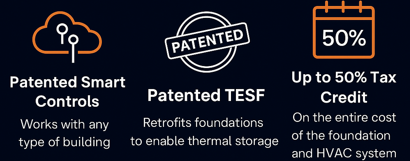
ThermoVault is more than a foundation. It is a modular platform designed to help builders, homeowners, and retrofit projects use thermal storage in a practical way.

ThermoVault Thermal Energy Storage Foundation

A foundation-based thermal storage system that puts building mass to work.

Integrated hydronic hardware

Manifolds, valves, meters, and control-ready components that simplify installation and operation.

Smart controls

A control layer that can monitor temperatures, flow, operating windows, and system behavior so storage can be used more deliberately and consistently.

Optimization tools

Software and design tools that help size, monitor, and improve system performance over time.

Our Vision

We believe affordable comfort should not depend on waste, oversized systems, or expensive peak energy. Buildings should be able to store energy, move it intelligently, and use it when it makes the most sense.

ThermoVault’s vision is to make thermal storage practical for real buildings—new homes, retrofits, and commercial projects alike—by combining building mass, floor heat, controls, and modern monitoring into one integrated approach.

Build better. Store smarter. Deliver comfort more affordably.

bottom of page